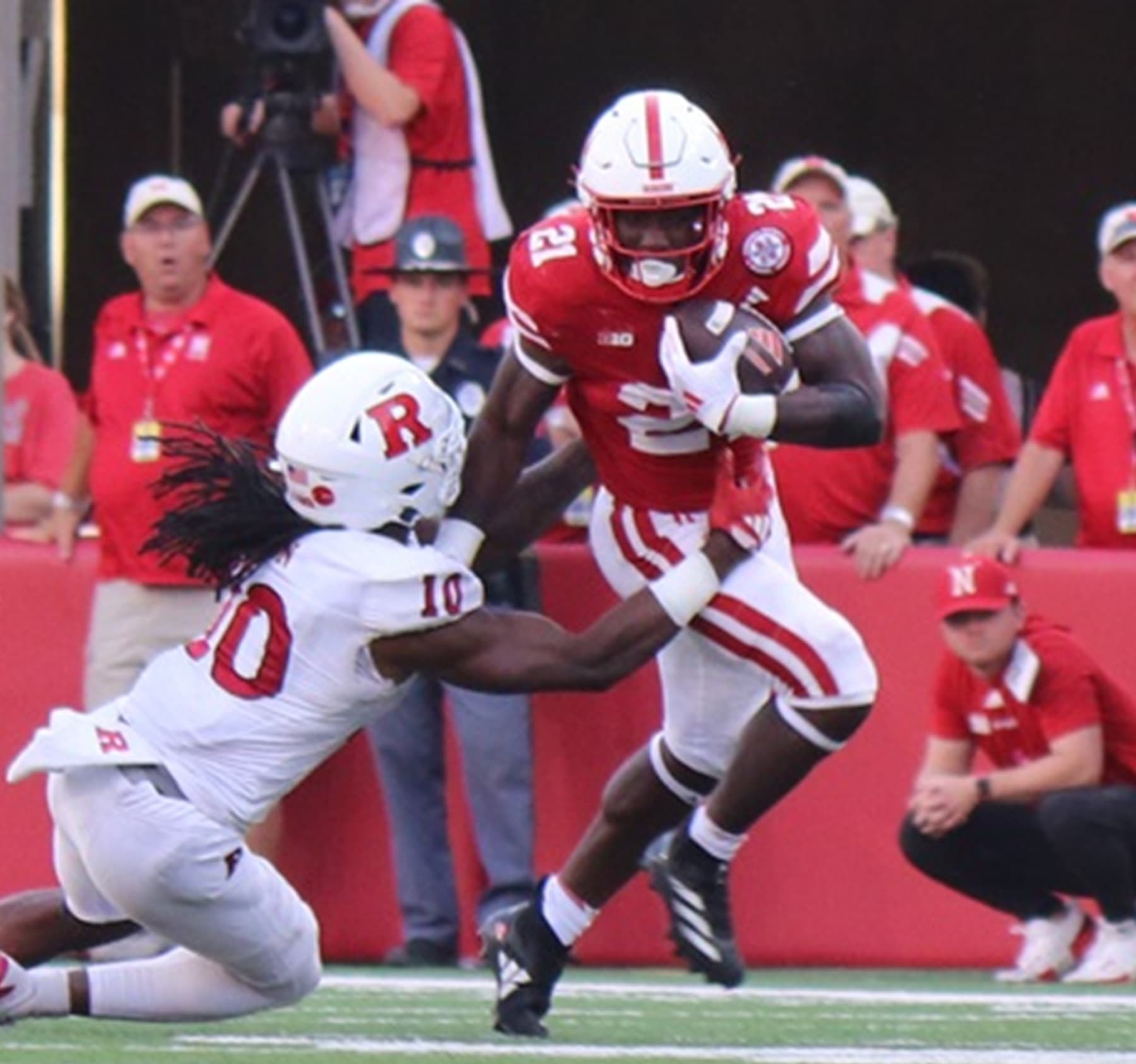

There isn’t enough talk in Husker Nation about what Nebraska running back Emmett Johnson accomplished this season. Yes, we all puff our chest out with pride for Johnson being named the Ameche-Dayne Big Ten Running Back of the Year. And yes, we are quick to point our he was a First Team All-American, which is a big deal because he is the first Nebraska running back to earn All-American honors since Heisman Trophy winner Mike Rozier in 1983.
Yet I’m afraid we’re missing what Johnson’s season truly means to the University of Nebraska and Husker fans.
In the 2025 season Emmett Johnson rushed for 1,451 yards on 251 carries for a 5.8 yard per carry average and scored 12 touchdowns. He also had 45 receptions for 370 yards and 3 touchdowns. His 1,451 yards rank him in the top 10 in school history, which is the most by a Husker running back since 2014. His 1,821 yards from scrimmage ranks 2nd nationally and 1st among Power Four Conference players.
Now add that pro football analyst Mel Kiper ranked Johnson as one of the top three running backs in the upcoming NFL draft and you realize how good he was this season. Kiper has him just behind Notre Dame’s Jeremyiah Love and ahead of players like Washington’s Jonah Coleman, along with Penn State’s Kaytron Allen and Nick Singleton. That’s select company when you consider Johnson’s name wasn’t even mentioned as being a top back before the season started.
So, why do I want to make it an even bigger deal than it is? Because there was a time Nebraska was known as “I-Back U.” Johnson’s season is the first step in the return to a legacy that has been missing for far too long. Yes, I know we are not going to see the return of the I-formation and the option. We aren’t going to see our quarterback and multiple running backs with over 100 yards rushing a game, not in Dana Holgorsen’s offense anyway. Those days are long gone.
What I am suggesting is that Emmett Johnson has set the standard. Now that it’s been renewed, it should be the goal of every running back who wears the ‘N’ to be the next 1,000-yard rusher. Why? Because wins come with 1,000-yard rushing seasons.
You don’t believe me. Then just look at the numbers below. It doesn’t matter what offense you run, if you can’t run the ball you don’t win.
HC Tom Osborne, 25 seasons, 18 – 1,000-yard rushers, Record 255-49-3.
1973 – Tony Davis – 1,008 yards
1977 – I.M Hipp – 1,031 yards
1979 – Jarvis Redwine – 1,042 yards
1980 – Jarvis Redwine – 1,119 yards
1981 – Roger Craig – 1,060 yards
1982 – Mike Rozier – 1,689 yards
1983 – Mike Rozier – 2,148 yards
1984 – Doug DuBose – 1,040 yards
1985 – Doug DuBose – 1,161 yards
1987 – Keith Jones – 1,232 yards
1988 – Ken Clark – 1,497 yards
1989 – Ken Clark – 1,196 yards
1991 – Derek Brown – 1,313 yards
1992 – Calvin Jones – 1,210 yards
1993 – Calvin Jones – 1,043 yards
1994 – Lawrence Phillips – 1,722 yards
1995 – Ahman Green – 1,086 yards
1997 – Ahman Green – 1,877 yards
HC Frank Solich, 6 Seasons, 3 – 1,000-yard rushers, Record 58-19.
2000 – Dan Alexander – 1,154 yards
2001 – Dahrran Diedrick – 1,299 yards
2002 – Jamal Lord – 1,412 yards
HC Bill Callahan, 4 Seasons, 2 – 1,000-yard rushers, record 27-22.
2004 – Cory Ross – 1,102 yards
2007 – Marlon Lucky – 1,019 yards
HC Bo Pelini, 7 Seasons, 6 – 1,000-yard rushers, record 67-27.
2009 – Roy Helu – 1,147 yards
2010 – Roy Helu – 1,245 yards
2011 – Rex Burkhead – 1,357 yards
2012 – Ameer Abdullah – 1,137 yards
2013 – Ameer Abdullah – 1,690 yards
2014 – Ameer Abdullah – 1,611 yards
HC Mike Riley, 3 Seasons, 0 – 1,000-yard rushers, record 19-19.
HC Scott Frost, 5 seasons, 1 – 1,000-yard rusher, record 16-31.
2018 – Devine Ozigbo – 1,082 yards
HC Matt Rhule, 3 Seasons 1 – 1,000-yard rusher, record 19-19.
2025 – Emmett Johnson – 1,451 yards
The numbers don’t lie. Osborne had a 1,000- yard rusher 18 of 25 seasons for an average of 9.96 wins per season. Solich had a 1,000- yard rusher 3 of 6 seasons for an average of 9.66 wins per season. Pelini had a 1,000- yard rusher 6 of 7 seasons for an average of 9.57 wins per season. Callahan, Riley, Frost, and Rhule had a 1,000- yard rusher 4 times in 15 seasons for an average of 5.4 wins a season. Nebraska doesn’t win when they can’t run the ball.
So. it’s clear what Rhule needs to accomplish to get his team to the next level, and it starts with stacking 1,000-yard rushing seasons. Emmett Johnson took the first step. He set the standard. Now it’s on Rhule to recognize that and gather his coaches around the white board. Holgorsen, Wade, and Barthel should be on a singular mission, running the ball effectively and consistently. Start stacking 1,000-yard seasons and have players scratching and clawing to be the next guy in line. Do that and you start stacking wins in the Big Ten.
GO BIG RED!! SIMPLE, FAST, VIOLENT!!
Photo courtesy of The Falls City Journal
Stay on top of Husker football at CarrikerChronicles.com